



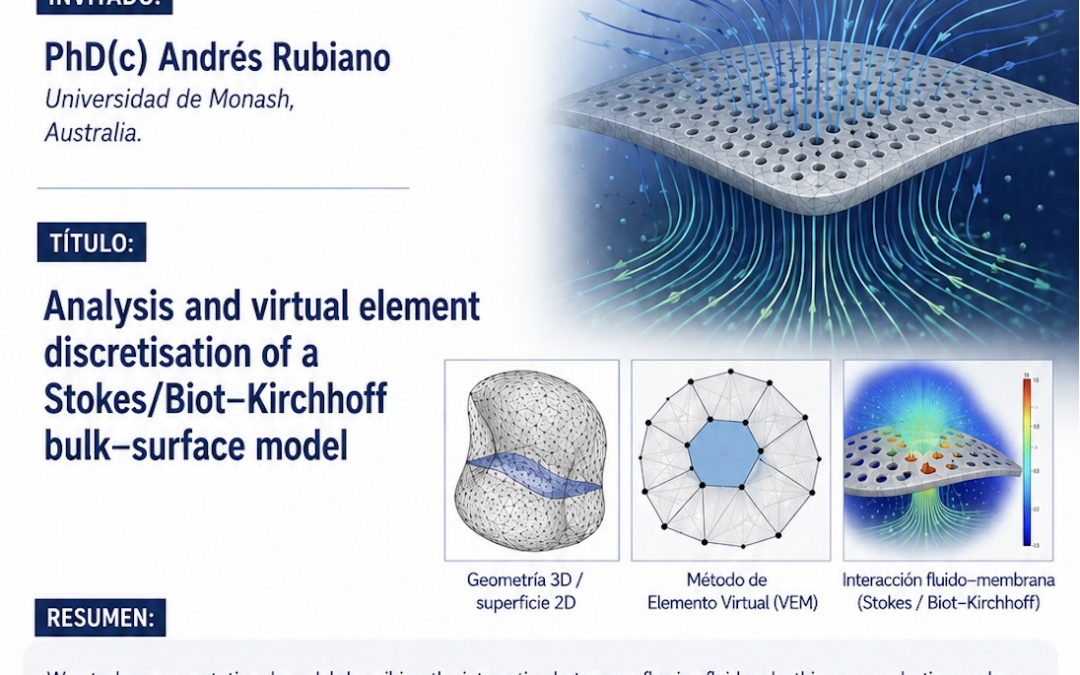
PhD(c) Andrés Rubiano, Universidad de Monash, Australia.
Resumen: We study a computational model describing the interaction between a flowing fluid and a thin porous elastic membrane. The fluid motion is represented by Stokes flow in the surrounding 3D region, while the membrane dynamics are described by poroelastic plate equations that capture both deformation and transport processes on a 2D surface. We show that the mathematical model is well-posed, ensuring that simulations produce a unique and physically meaningful solution.
To solve this problem computationally, we develop a stable virtual element method capable of handling complex geometries commonly encountered in engineering and biological applications. The proposed numerical approach is proven to be stable and accurate, and an efficient fixed-point strategy is introduced for practical implementation. We establish theoretical guarantees for the accuracy of the method and validate these results through computational experiments. Finally, we demonstrate the applicability of the framework through simulations of immune isolation technologies based on encapsulation devices with silicon nanopore membranes, which are relevant for biomedical applications such as cell therapies and implantable devices.
